
Antispam, Best practices, BIMI
Antispam, Best practices, BIMI
There are more than 1.8 billion Gmail users globally¹. Last year the most popular email service on the planet introduced Brand Indicators for Message Identification (BIMI). This email specification, taking care of identifying the content and its authors helps fight phishing and improve safety, while building trust and brand identity.
The average user deletes nearly half of the emails they receive². Many of them are not even opened. The amount of phishing messages has been rising over the last years – that is why people are more careful when it comes to opening the received emails. For companies, BIMI means more trust from their recipients, who feel secure to open the verified emails. It is a step forward towards a higher security level in communication between users and companies.
BIMI enables the use of brand-controlled logos within supporting email clients. It uses a text file that follows a specific format and is placed on your sending servers. In practice, BIMI allows your company to publish a new, standardized DNS record for your domain. It means that by using this standard, your company logo will be visualized next to your email in the customer inbox. Before it happens, the URL to the logo is scanned and validated with VMC, and it needs to pass the DMARC authentication check. A supporting mailbox provider checks the domain DMARC policy to verify if it is on the BIMI validation list.
The multi-step process helps ensure that your company’s data aligns with your owned brand domain, checking it against impersonation. BIMI solves the main problem, and that is that you need to prove you own the right to the brand logo. Its role is to protect your organization by ensuring that the recipients get the emails sent by your company and not by somebody else on your behalf.
BIMI is essential for your brand’s visibility and email deliverability. By using your logo and increased protection provided by DMARC enforcement, your brand has a chance to, first of all, improve your odds of making it to the inbox and, secondly, to stand out among other messages in the mailbox.
For your company, BIMI means building brand identification and trust between the company and the consumers. Since it is a free standard, you have an opportunity to get added value to your email program without any investment. Of course, it cannot guarantee inbox placement, so you still need to follow email best practices, but it undoubtedly improves your brand’s visibility, gives you control over your logo and higher recipients’ engagement.
One of the first companies that used BIMI during the pilot implementation was Groupon, and they confirmed the standard’s value. The company noticed an improvement in consumer confidence. “By increasing consumer confidence in the authenticity of our messages, we believe BIMI will increase response rates, magnifying the power and reach of our marketing efforts.”. – Torsten Reinert, Groupon.
Since before BIMI, DMARC was the authentication tool, many companies tried to pull their logo into the inboxes. The problem that BIMI solves is related to gaining better control over which logo will be displayed. With the goal in mind, email recipients shall identify trustworthy emails in one glimpse. The brand awareness build by visualizing the logo is a ‘good-to-have, but the real value lies in the trust that it creates.
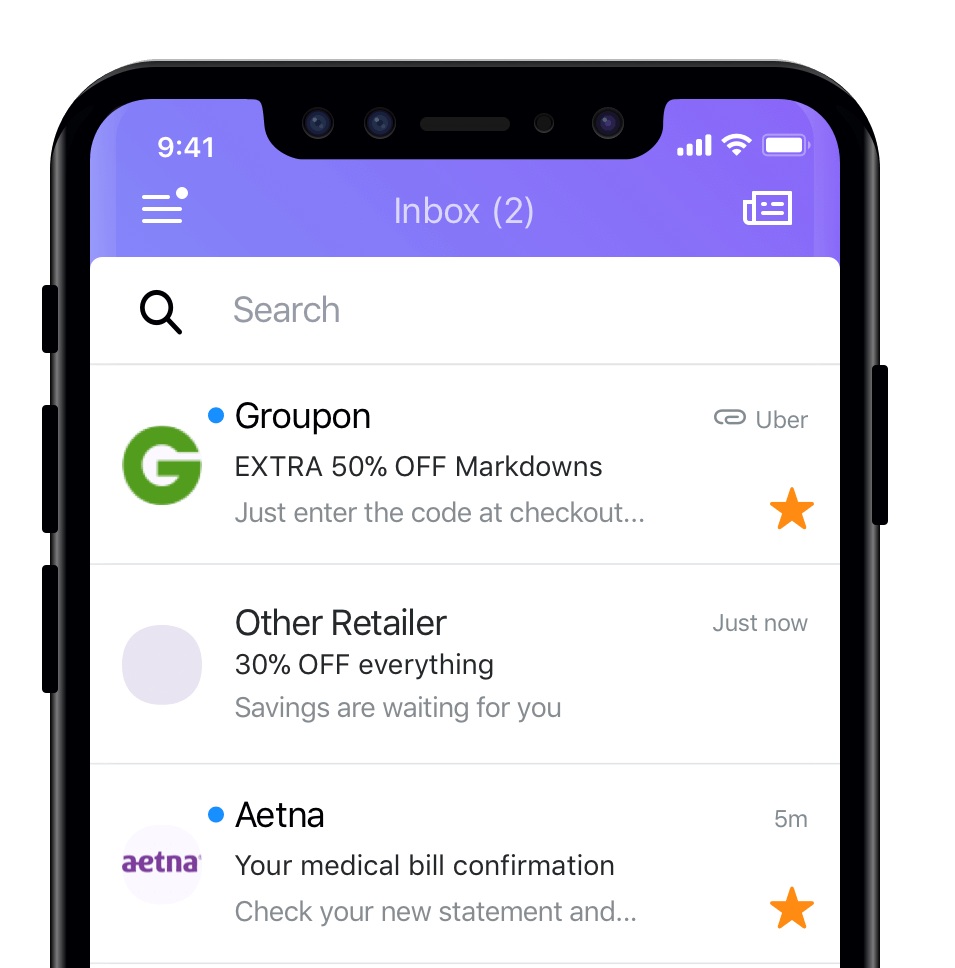
Emails from the BIMI; Source: Yahoo! Mail
Google is currently still running a closed pilot, but BIMI will soon be available to the broad public. That is why Google is offering support for the BIMI, encouraging the companies to implement DMARC, which is essential for introducing the new standard. For a proper setup, your company needs to follow authentication best practices. You must use SPF, DKIM and DMARC to take advantage of the free BIMI standard shortly. Some mailbox providers might request the Verified Mark Certificate, but VMC is only being issued to domains participating in the BIMI pilot. The three authentication methods build a basis for BIMI, allowing for security. So when you have the above-mentioned authentication methods in place, you need to publish your logo in the DNS record. At the moment, BIMI supports one logo for multiple domains and subdomains.
3 steps to get BIMI running:
Since BIMI is a pretty new solution, not all mailbox providers support it. In 2020, companies like Verizon Media Group (Yahoo!, AOL), Netscape, Fastmail, and Google (Gmail) enrolled on BIMI pilot. Comcast and Czech provider Seznam.cz are planning to follow. The ones who are not going to offer BIMI support, for now, are Microsoft, 1&1 and Yahoo Japan.
When fraudulent emails, data breaches and email hackers are on the rise, you cannot afford a future without security identification. BIMI will be a new standard, allowing your company and your customers to feel safer online. Your logo will be incorporated into more online experiences. You will get control over which logo will be used, allowing your company to gain brand consistency and prevalence. Your emails with a logo will produce billions of new free brand impressions in practice, enabling the end-users to get an easier-to-use experience online. They will find your email faster and recognize it very quickly when seeing the logo.
BIMI will allow greater safety because the ecosystem that supplies consumers with experiences will be made safer. Keep an eye on our blog – we will inform you about any updates regarding the BIMI standard’s availability.
¹ https://financesonline.com/number-of-active-gmail-users/
² https://emailanalytics.com/gmail-statistics/


Head of Marketing
As an Enterprise B2B Marketing Manager with a background in the email deliverability industry, I bring experience in crafting marketing strategies that boost engagement rates and optimize performance for large-scale enterprises. My expertise lies in merging data-driven insights with innovative marketing techniques to ensure that every campaign not only reaches its intended audience but also engages and converts. 🎯 In private - love animals more.. than everything. :)
See more articles
We live in a world where your customers switch seamlessly between laptops, smartphones, and tablets. They navigate a complex digital ecosystem – checking emails, using mobile apps, and reacting...
We are delighted to announce that Vercom S.A., the company behind the EmailLabs project, has successfully completed the ISO 22301 certification process. This significant achievement underscores our commitment to...

EmailLabs, as part of the Vercom group, proudly announces its full commitment to aligning its ICT services with the latest cybersecurity standards. In response to dynamically changing regulations, the...
We are pleased to announce that MessageFlow, a product from the Vercom S.A. group, has received the prestigious CSA (Certified Senders Alliance) Certification. This recognition not only underscores the...
Compliance & Security, Email Marketing, Security
TL;DR DMARCbis is now official: After years of work by the IETF working group, the DMARC specification has been formally updated. Three new documents, RFC 9989, RFC 9990, and...
Email Marketing, Gmail, New feature
TL;DR Gmail Live: a new feature enabling natural language voice search in the inbox, powered by the Gemini model. AI Inbox and AI Overviews: a revamped inbox interface featuring...
Best practices, Best practices, Email Authentication
TL;DR: Strategic Takeaways for C-Level and Marketing Leaders DKIM2 is not a minor DNS configuration update. It is a systemic response to two critical business problems: Replay attacks: scenarios...
Compliance & Security, Email Marketing, Security
TL;DR DMARCbis is now official: After years of work by the IETF working group, the DMARC specification has been formally updated. Three new documents, RFC 9989, RFC 9990, and...
Email Marketing, Gmail, New feature
TL;DR Gmail Live: a new feature enabling natural language voice search in the inbox, powered by the Gemini model. AI Inbox and AI Overviews: a revamped inbox interface featuring...
Best practices, Best practices, Email Authentication
TL;DR: Strategic Takeaways for C-Level and Marketing Leaders DKIM2 is not a minor DNS configuration update. It is a systemic response to two critical business problems: Replay attacks: scenarios...
AI, Antispam, Best practices, Deliverability
C-Level TL;DR: Strategic Takeaways Recipient consent as a foundation (Item 0): Sending email messages without explicit recipient consent (opt-in) poses a significant risk to your sending infrastructure. Attempting to...
AI, Antispam, Best practices, Deliverability
Executive TL;DR: Strategic Takeaways Deliverability Schism: The growing divide between sales automation technologies and the security standards enforced by major global mailbox providers (collectively referred to as MAGY) is...
Modern email systems no longer treat the primary inbox as the default destination for every message. The final classification of an email is the result of a multistage evaluation...
Best practices, Maile marketingowe, Marketing E-mails, Transactional Emails
Mass email sending is a critical strategy for business owners, marketers, developers, and nonprofit managers looking to scale their outreach. Whether you are announcing a new product feature, distributing...

Best practices, Marketing E-mails
Customer feedback is the fuel for business growth, but gathering it effectively requires more than just a list of questions. Survey emails remain the most direct channel for understanding...
Best practices, Email Marketing, Pytania i odpowiedzi
Mail merge combines a template document with data to create personalized communications. This technique saves time by automatically generating individualized letters, emails, and labels without manual entry. What Is...