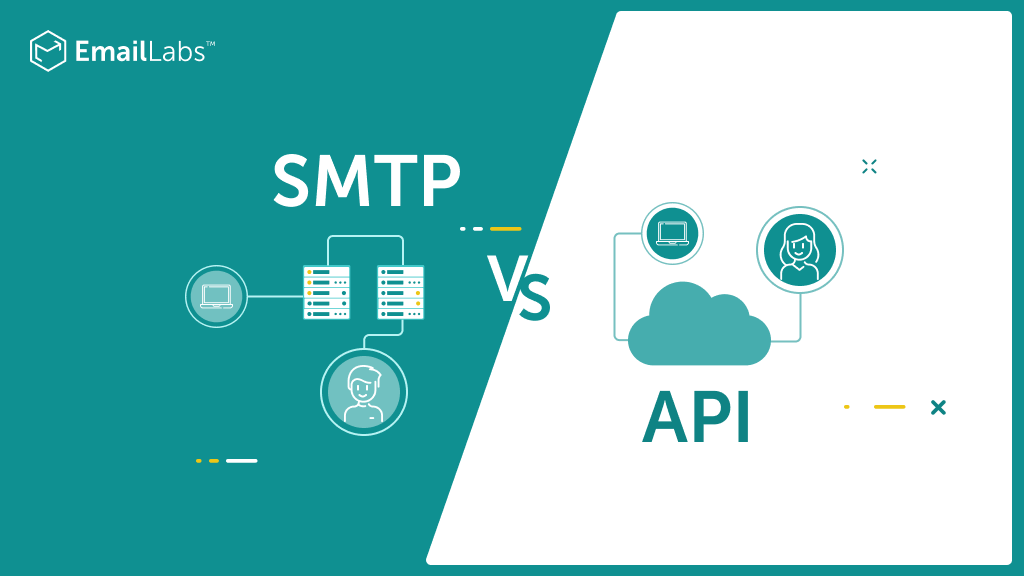
EmailLabs is committed to providing its customers with the most tailored solution, so it offers email sending through both SMTP and API integration. Which of these options is best for your business? The answer to this question is complex and largely depends on the resources available and your requirements in terms of volume. So in this blog post, we’ll look at the characteristics of both SMTP and API, focusing on their features.
SMTP (Simple Mail Transfer Protocol) is a communication protocol designed to send email using a set of commands that authenticate and direct the transmission of email. SMTP provides a mechanism for transferring messages directly from the sending server to ultimate recipient , or through a number of intermediate relay or getaway hosts on its path .
API is an application programming interface, made out of a set of rules by which computer programs can share data between the two. In other words, an API defines how applications can communicate with each other. With an email API, an online store website can automatically send both transactional and marketing messages in response for specific events. Moreover , API integration also allows using templates and gives access to various types of data and statistics .
The choice of integration method is not always dictated by the type of messages sent, but the customer’s needs or technical possibilities. API grants additional capabilities not offered by other protocols like SMTP. but requires knowledge or technical background. On the other hand, as developers admit, working with this interface is highly intuitive because it is more common and has a wider application (e.g. Google Maps).
SMTP offers default integration from e.g. email sending platforms, marketing automation programs, online stores (PrestaShop, WooCommerce etc.) or the popular WordPress. As a result, adding a new integration is reduced to a few basic steps that do not require programming knowledge.
API makes it easy to send emails, especially transactional ones, from within your app or website. Our customer made a purchase? Let’s send him a confirmation email. When an order is submitted, let’s automatically add a tracking number. What’s more, the email API also gives easy access to a lot of data such as messages statuses. So, if you handle high-volume marketing or transactional mailings daily and need advanced options at the same time, it’s worth choosing integration via API.
The SMTP protocol is a universal standard that is often used for sending transactional or marketing messages. Even though it offers fewer options, this solution provides great control over mailings, while allowing faster integration with e.g. CRM systems. As a result, it’s a good solution for senders who send fewer emails and expect simple integration and maintenance.
To provide the highest possible flexibility to its customers, EmailLabs offers both SMTP and API integration. As a result, each company can choose the solution that best fits their individual requirements, available resources, and business goals. Thus, regardless of whether we have a store, billing, accounting, CRM, ERP, CMS or dedicated Marketing Automation system – in each of the above , the implementation of sending via SMTP will take only a moment. On the other hand, API supports the REST standard that enables full integration with your IT systems, offering quick connections to EmailLabs infrastructure and the possibility of collecting the necessary data (in retention period) with no need to log into the control panel.
Want to learn more about the differences between API and SMTP? Contact us and EmailLabs specialists will be happy to answer any of your questions and recommend which solution is best for your company.


Product and Technical Insights Specialist
Natalia abandoned her career as an experimental biologist for the digital universe and new technologies. She likes to know something about everything and everything about something. Breathlessly follows and describes news from the email world. Supports EmailLabs users in integrating, analyzing, and reporting deliverability. Helps to increase domain security with implemented DNS records and BIMI standard, moreover educates on good mailing practices.
See more articles
We live in a world where your customers switch seamlessly between laptops, smartphones, and tablets. They navigate a complex digital ecosystem – checking emails, using mobile apps, and reacting...
We are delighted to announce that Vercom S.A., the company behind the EmailLabs project, has successfully completed the ISO 22301 certification process. This significant achievement underscores our commitment to...

EmailLabs, as part of the Vercom group, proudly announces its full commitment to aligning its ICT services with the latest cybersecurity standards. In response to dynamically changing regulations, the...
We are pleased to announce that MessageFlow, a product from the Vercom S.A. group, has received the prestigious CSA (Certified Senders Alliance) Certification. This recognition not only underscores the...

Modern email systems no longer treat the primary inbox as the default destination for every message. The final classification of an email is the result of a multistage evaluation...
Best practices, Maile marketingowe, Marketing E-mails, Transactional Emails
Mass email sending is a critical strategy for business owners, marketers, developers, and nonprofit managers looking to scale their outreach. Whether you are announcing a new product feature, distributing...

Best practices, Marketing E-mails
Customer feedback is the fuel for business growth, but gathering it effectively requires more than just a list of questions. Email surveys remain the most direct channel for understanding...
Modern email systems no longer treat the primary inbox as the default destination for every message. The final classification of an email is the result of a multistage evaluation...
Best practices, Maile marketingowe, Marketing E-mails, Transactional Emails
Mass email sending is a critical strategy for business owners, marketers, developers, and nonprofit managers looking to scale their outreach. Whether you are announcing a new product feature, distributing...
Best practices, Marketing E-mails
Customer feedback is the fuel for business growth, but gathering it effectively requires more than just a list of questions. Email surveys remain the most direct channel for understanding...
Best practices, Email Marketing, Pytania i odpowiedzi
Mail merge combines a template document with data to create personalized communications. This technique saves time by automatically generating individualized letters, emails, and labels without manual entry. What Is...
IT & Tech, Pytania i odpowiedzi, Technical
When an email travels from sender to recipient, it passes through several critical components of email infrastructure. At the heart of this journey sits the Mail Transfer Agent (MTA)...
Best practices, Deliverability, Google and Yahoo's Requirements, Pytania i odpowiedzi
The world of email marketing is constantly evolving, and leading mail service providers – Gmail, Yahoo, Microsoft, and Apple – regularly update their guidelines for senders. In recent years,...
Gmail, Google and Yahoo's Requirements
You might have noticed a new item in your Gmail sidebar recently – the “Manage subscriptions” tab, often flagged with a blue notification dot. While Google announced this feature...
IT & Tech, Pytania i odpowiedzi, Technical
Efficient email communication isn’t just about sending messages — it also involves integrating email functionality into your business systems and applications. Email APIs (Application Programming Interfaces) serve as the...

One of the most important yet often underestimated elements in shaping a company’s brand perception is the transactional email. In e-commerce, the design of such messages must be carefully...
