
Email Marketing, Gmail, New feature
Email Marketing, Gmail, New feature
TL;DR
This year’s Google I/O 2026 brought significant changes across the Google Workspace ecosystem. In previous years, artificial intelligence in Gmail was largely an optional add-on: useful, but easy to ignore. The latest announcements point in a different direction – AI is stepping out of the background and becoming the central layer of communication management.
With Gmail supporting over 4 billion users today, any change to the interface or sorting algorithms has real implications for the entire industry. What Google announced at I/O goes beyond end-user convenience – it changes the rules for high-volume senders and email marketers.
Below, we cover the key updates: how Gmail Live voice search works, what’s behind the personalized AI Inbox, and which premium features are coming to free accounts. At the end, what all of this means for campaign performance and email deliverability.
One of the most widely discussed features from Google I/O 2026 is Gmail Live: a voice search tool for your inbox. It operates within the AI Inbox environment and changes how users find information buried in their emails.
Instead of typing keywords into the search bar, users simply ask a question out loud. The Gemini model scans message content, analyzes context, and returns a specific answer. The feature is designed for situations where there’s no time to manually search through the inbox – which is usually exactly when you need that information most.

Sample queries supported by Gmail Live:
Gmail Live handles follow-up questions and seamless topic shifts mid-conversation. The model also understands linguistic nuances – it can distinguish a child’s school trip from a private getaway based purely on context from previous emails.
One important note: Gmail Live does not replace classic text search – it complements it. The rollout begins in summer 2026, starting with Google AI Pro and Ultra subscribers, followed by a preview for Google Workspace business customers.
The AI Inbox officially launched in January 2026, but the updates from Google I/O give it real, practical shape. Instead of a chronological list of messages, users see an inbox sorted by priority, factoring in relationship context and past activity.
The interface is divided into two sections. The first is “Suggested Tasks,” grouping messages that require a specific action. The second is “Topics to Catch Up On,” collecting notifications and less urgent threads in one place.

Google I/O introduced three significant additions to this system:
AI Inbox also gained integration with AI Overviews in Gmail search. Instead of typing keywords, users can ask a question in natural language – the model will search the inbox and return a concise summary of the most relevant information.
Google continues to expand its writing tools in Gmail. The new Proofread feature is the next step in that direction – this time focused not on generating text from scratch, but on refining what the user has already written. The difference from Help Me Write is fundamental: that feature drafts a message from a short prompt, while Proofread polishes it.
The tool goes well beyond standard spelling and grammar correction. The algorithm analyzes text for clarity, suggests swapping passive voice for active, recommends more precise word choices, and helps trim overly long sentences.

Integrating an advanced proofreader directly into Gmail is a direct answer to the popularity of external tools like Grammarly. For business users, the native solution has an added advantage: message content stays entirely within the closed Google Workspace ecosystem and never reaches third-party servers.
Proofread currently works in English only. For personal accounts, it’s also limited to users in the United States. Google Workspace customers have global access, but again, English only. The feature is available to Google AI Pro and Ultra subscribers.
Alongside premium updates, Google is opening access to selected AI features for all users, regardless of plan. Three tools previously reserved for paid subscribers are now available on free accounts:

This has a clear strategic rationale. Google wants to get billions of users comfortable with AI as part of their daily routine – and in the process, collect real interaction data at scale, speeding up the development of its language models.
Individual features are being released in stages. The table below shows the current rollout status:
| Feature | Timeline | Availability |
|---|---|---|
| Help Me Write and Suggested Replies | Now | All users |
| AI Inbox (basic version) | Now | Google AI Ultra, gradually Pro and Plus |
| AI Overviews in search | Now | Google AI Pro and Ultra |
| Proofread | Now | Google AI Pro and Ultra |
| Gmail Live (voice search) | Summer 2026 | Google AI Ultra, eventually Pro and a preview for Workspace |
This schedule is based on Google’s global announcements. Keep in mind that actual rollout dates depend on region and interface language. Advanced Gemini language features typically launch with full English support first, so localized versions may roll out later.
Artificial intelligence is becoming the new filter for recipient attention. Users no longer need to manually scan dozens of messages – the algorithm does it for them. For high-volume senders, this means it’s time to revisit existing campaign optimization practices.
Here’s what’s changing:
Here are a few optimizations worth implementing to stay ahead in an inbox shaped by Gmail’s new AI features:
Artificial intelligence is no longer just an add-on to Gmail – it’s becoming its core. The battle for recipient attention is shifting toward working with sorting algorithms, and content needs to be created with both human readers and the machines that pre-process it in mind.
To keep up with how changes in the email ecosystem affect deliverability and campaign performance, take a look at these resources:

Product and Technical Insights Specialist
Natalia abandoned her career as an experimental biologist for the digital universe and new technologies. She likes to know something about everything and everything about something. Breathlessly follows and describes news from the email world. Supports EmailLabs users in integrating, analyzing, and reporting deliverability. Helps to increase domain security with implemented DNS records and BIMI standard, moreover educates on good mailing practices.
See more articles
We live in a world where your customers switch seamlessly between laptops, smartphones, and tablets. They navigate a complex digital ecosystem – checking emails, using mobile apps, and reacting...
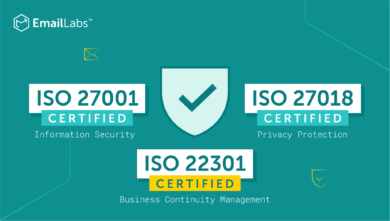
We are delighted to announce that Vercom S.A., the company behind the EmailLabs project, has successfully completed the ISO 22301 certification process. This significant achievement underscores our commitment to...

EmailLabs, as part of the Vercom group, proudly announces its full commitment to aligning its ICT services with the latest cybersecurity standards. In response to dynamically changing regulations, the...
We are pleased to announce that MessageFlow, a product from the Vercom S.A. group, has received the prestigious CSA (Certified Senders Alliance) Certification. This recognition not only underscores the...
Compliance & Security, Email Marketing, Security
TL;DR DMARCbis is now official: After years of work by the IETF working group, the DMARC specification has been formally updated. Three new documents, RFC 9989, RFC 9990, and...
Email Marketing, Gmail, New feature
TL;DR Gmail Live: a new feature enabling natural language voice search in the inbox, powered by the Gemini model. AI Inbox and AI Overviews: a revamped inbox interface featuring...
Best practices, Best practices, Email Authentication
TL;DR: Strategic Takeaways for C-Level and Marketing Leaders DKIM2 is not a minor DNS configuration update. It is a systemic response to two critical business problems: Replay attacks: scenarios...
Compliance & Security, Email Marketing, Security
TL;DR DMARCbis is now official: After years of work by the IETF working group, the DMARC specification has been formally updated. Three new documents, RFC 9989, RFC 9990, and...
Email Marketing, Gmail, New feature
TL;DR Gmail Live: a new feature enabling natural language voice search in the inbox, powered by the Gemini model. AI Inbox and AI Overviews: a revamped inbox interface featuring...
Best practices, Best practices, Email Authentication
TL;DR: Strategic Takeaways for C-Level and Marketing Leaders DKIM2 is not a minor DNS configuration update. It is a systemic response to two critical business problems: Replay attacks: scenarios...
AI, Antispam, Best practices, Deliverability
C-Level TL;DR: Strategic Takeaways Recipient consent as a foundation (Item 0): Sending email messages without explicit recipient consent (opt-in) poses a significant risk to your sending infrastructure. Attempting to...
AI, Antispam, Best practices, Deliverability
Executive TL;DR: Strategic Takeaways Deliverability Schism: The growing divide between sales automation technologies and the security standards enforced by major global mailbox providers (collectively referred to as MAGY) is...
Modern email systems no longer treat the primary inbox as the default destination for every message. The final classification of an email is the result of a multistage evaluation...
Best practices, Maile marketingowe, Marketing E-mails, Transactional Emails
Mass email sending is a critical strategy for business owners, marketers, developers, and nonprofit managers looking to scale their outreach. Whether you are announcing a new product feature, distributing...

Best practices, Marketing E-mails
Customer feedback is the fuel for business growth, but gathering it effectively requires more than just a list of questions. Survey emails remain the most direct channel for understanding...
Best practices, Email Marketing, Pytania i odpowiedzi
Mail merge combines a template document with data to create personalized communications. This technique saves time by automatically generating individualized letters, emails, and labels without manual entry. What Is...