
AI, Antispam, Best practices, Deliverability
AI, Antispam, Best practices, Deliverability

Executive TL;DR: Strategic Takeaways
Understanding the mechanisms behind behavioral silent engagement decay, discussed in the article Email Deliverability in the AI Era: Why a 99% Delivery Rate Is Not Enough?, is only the starting point for modern email marketing. At the same time, a much broader systemic issue is emerging across the market.
This phenomenon, referred to in recent industry analysis as the Deliverability Schism, reflects a growing conflict between scale-driven sales automation technologies and the increasingly restrictive, user-protection-focused security standards enforced by mailbox providers.
As a result, a high technical delivery rate no longer guarantees actual inbox visibility. This represents a qualitative shift rather than a quantitative one: technical compliance of the sending infrastructure is no longer a sufficient condition for campaign success.
Today, email deliverability is shaped by three parallel forces operating across different layers of the communication stack:
These forces collectively form the foundation of the Deliverability Schism. Within this framework, activities that sales teams often interpret as “reach optimization” – such as volume masking techniques or simulated engagement – are classified by filtering algorithms as attempts to manipulate sender reputation.

As a result, evaluating the effectiveness of outbound campaigns is evolving into a multidimensional model that combines infrastructural compliance, semantic message quality, and the increasing strictness of legal regulations.
The modern email ecosystem is largely shaped by its four dominant providers: Microsoft, Apple, Google, and Yahoo. Together, they control a substantial share of the global email infrastructure and are often collectively referred to in industry literature as MAGY.
In 2024, these providers aligned their core requirements for bulk senders, with a primary focus on domain authentication, unsubscribe mechanisms, and spam complaint rate thresholds. Current compliance guidelines indicate that MAGY requirements now represent a strict formalization of deliverability practices that previously existed only as industry recommendations.

Senders who fail to meet these standards face a significantly increased risk of having their messages classified as spam or rejected outright at the server level.
For a message to be successfully accepted by major mailbox provider servers, the sender’s domain must meet several critical technical requirements. The overview below explains not only how each protocol operates, but more importantly, its strategic role in the broader email deliverability landscape.
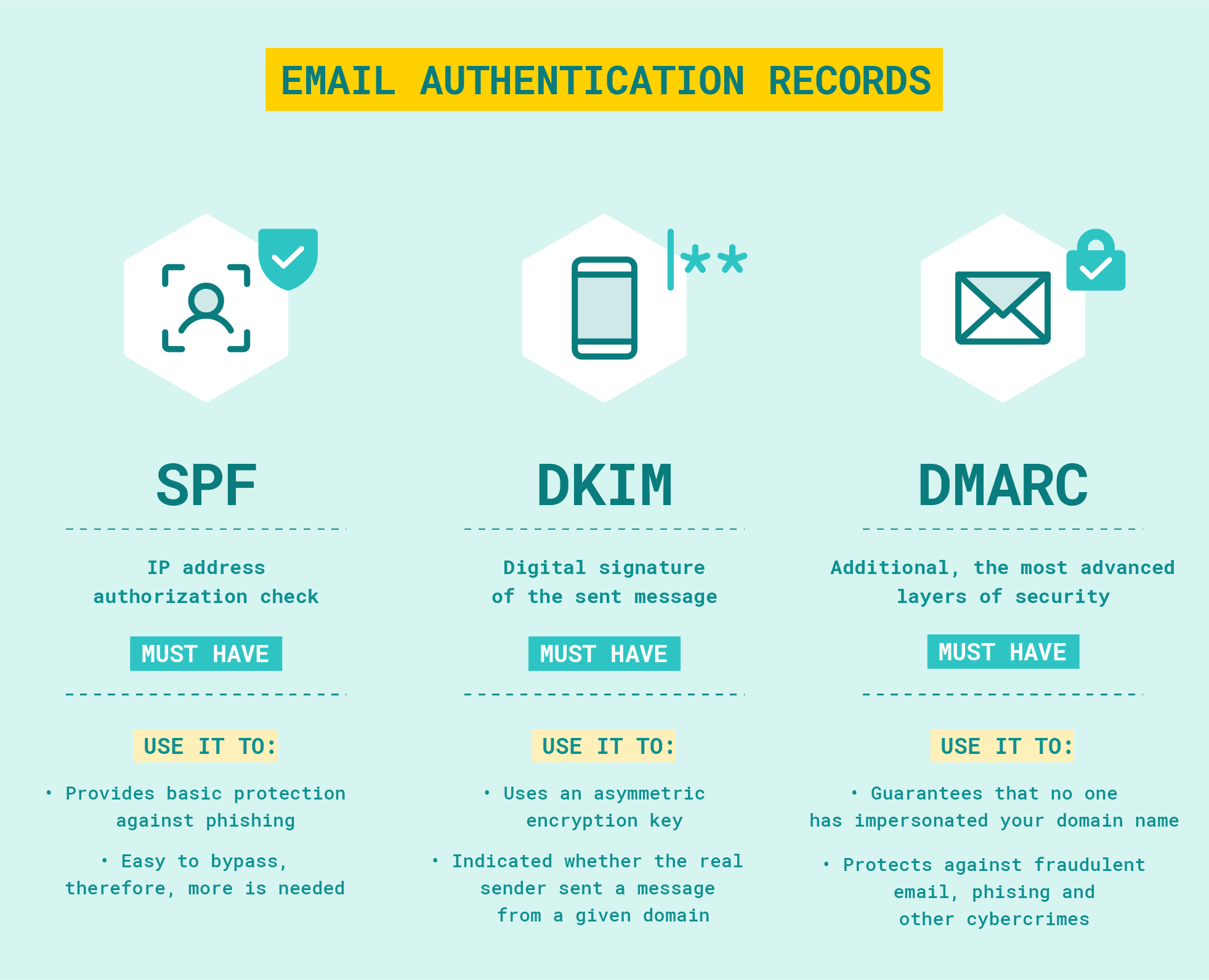
An SPF record defines a list of servers authorized to send emails on behalf of a given domain. This mechanism reduces the risk of sender impersonation via spoofing – a technique that forges the sender address to make a message appear legitimate.
From the MAGY perspective, a missing or misconfigured SPF record is treated as a strong negative signal, which may result in message rejection as early as the SMTP verification stage.
DKIM uses a cryptographic signature to verify message authenticity and ensure that content has not been altered in transit. The mechanism relies on a key pair: a private key used by the sender to sign outgoing messages, and a public key published in the domain’s DNS, which allows receiving servers to validate the signature.
For MAGY providers, DKIM is now considered a strict baseline requirement. It is no longer an optional enhancement, but a mandatory prerequisite for maintaining domain reputation.
DMARC acts as both a policy and reporting layer built on top of SPF and DKIM. It verifies alignment between the domain visible in the “From” header and the authenticated domains, and defines how receiving servers should handle messages that fail authentication.

DMARC supports three policy levels:
In addition, DMARC generates feedback reports: RUA reports provide aggregated data, while RUF reports deliver detailed forensic insights. These reports enable senders to monitor brand impersonation attempts and identify configuration issues within their sending infrastructure.
From an operational perspective, DMARC is the only authentication protocol that provides active feedback on the health of a sender’s infrastructure within the receiving ecosystem.
Proper DMARC configuration in an enforcement mode – quarantine or reject – goes beyond spoofing protection. It also enables the implementation of the BIMI (Brand Indicators for Message Identification) standard, which allows a verified company logo to be displayed directly in the inbox, supported by providers such as Gmail, Yahoo, and Apple Mail.
In an environment where sender trust is steadily declining, a verified logo becomes one of the strongest visual indicators of authenticity for B2B recipients.
Important Note: Technical compliance with SPF, DKIM, and DMARC now represents the absolute operational baseline. It ensures that a message is accepted at the server level, but does not guarantee inbox placement. The final decision is made by machine learning models that evaluate message quality, sender reputation, and behavioral context.
Beyond technical prerequisites, mailbox providers are placing increasing emphasis on communication quality and recipient engagement metrics. Throughout 2024 and 2025, these requirements have been significantly tightened, particularly for entities classified as bulk senders.
Within the Google and Yahoo ecosystems, this classification applies to senders who typically dispatch 5,000 or more messages per day to users of these services.
Many B2B senders assume that temporarily reducing sending volumes below the 5,000-message daily threshold will reset their status within the Google ecosystem. This assumption is incorrect.
Once the bulk sender threshold is exceeded, or if a domain is leveraged in a spoofing attack at a comparable scale, the sender’s infrastructure is permanently evaluated against the most stringent MAGY standards. Neither significant volume reduction nor extensive list cleaning will reverse this classification.

Architectural decisions related to the sending domain carry long-term, effectively irreversible consequences.
| MAGY Requirement | Operational Impact |
|---|---|
| Spam Complaint Rate | The warning threshold is set at 0.3%. The recommended level is strictly below 0.1%. Exceeding these thresholds may trigger volume throttling or complete blocking by filtering systems. |
| One-Click Unsubscribe (RFC 8058) | Google and Yahoo require bulk senders to implement a one-click unsubscribe mechanism directly within the message header, removing the need for users to visit an external landing page. |
| Hard Bounce Management | Sending emails to non-existent addresses generates hard bounces, which are interpreted as a clear indicator of poor list hygiene. A high hard bounce rate significantly degrades domain reputation. |
| Consent-Based Communication | Sending campaigns to ambiguously sourced or non-consented contact lists remains one of the primary factors negatively impacting message prioritization by ML-driven filtering systems. |
In 2025, Microsoft introduced additional standards for Outlook.com, Hotmail, and Live services. Messages that do not meet fundamental authentication requirements – including SPF, DKIM, and DMARC – may be rejected outright at the SMTP level.
At the same time, Microsoft is expanding mechanisms that limit outbound scale. One example is TERRL (Tenant External Recipient Rate Limit), implemented in Microsoft 365, which caps the number of messages that can be sent outside the organization based on the assigned license tier.
From an operational perspective, this means that the ability to execute large-scale communication is increasingly dependent not only on sender reputation but also on the structural footprint of the organization.
Apple applies a slightly different model within iCloud Mail. While it does not formally define a bulk sender threshold in the same way as Google, it strictly enforces proper authentication, frictionless unsubscribe mechanisms, and consistent sender identity.
Meeting MAGY infrastructural requirements ensures that a message is accepted by the receiving server, resulting in a high delivery rate. It does not guarantee visibility in the primary inbox.
The final classification decision is made by machine learning models that evaluate semantic message quality, sender reputation, and behavioral context – independently of whether the technical configuration is correct.
A detailed operational analysis of this distinction, along with its implications for sales teams, is provided in the article Outbound B2B in the AI Era: Building Effective B2B Outbound Without Spam Risk.
In November 2025, the Messaging, Malware and Mobile Anti-Abuse Working Group (M³AAWG) published a document titled Position on Cold Email, outlining practices related to bulk B2B communication and their impact on email infrastructure.

M³AAWG is an industry organization that brings together mailbox providers, technology vendors, and communication security firms, including representatives from Microsoft, Google, and Apple.
The document does not introduce new legal regulations. Instead, it formalizes the position of the infrastructure provider ecosystem on practices commonly used in mass B2B communication.
Within the email deliverability domain, M³AAWG publications are widely treated as a benchmark for sender best practices. These positions reflect both the actual evolution of filtering systems and the operational enforcement models applied by mailbox providers.
The document identifies several categories of practices that are interpreted as attempts to manipulate reputational systems – to mask true sending scale and simulate one-to-one communication patterns.
This technique involves generating large volumes of unique content variants using artificial intelligence to evade detection by pattern-based filtering systems, often referred to as footprinting.
The objective is to create the false impression that a bulk campaign consists of authentic one-to-one communication.
Modern machine learning systems used by mailbox providers are specifically designed to detect statistical anomalies in engagement distribution. Content generated dynamically by LLMs leaves identifiable mathematical patterns, which MAGY algorithms may classify as reputational manipulation.

A derivative of deceptive mimicry involves attempts to manipulate AI-powered inbox assistants by embedding hidden text – often referred to as invisible ink – directly within the message code. This hidden layer may contain aggressive or misleading content intended to influence automated summaries presented to the recipient.
From the perspective of MAGY filtering systems, this is a well-known deception technique called cloaking, where the content shown to the user differs from the content analyzed by algorithms.
Detection of this practice typically results in immediate and often permanent blacklisting of the sender’s domain, including listing by organizations such as Spamhaus.
This practice involves registering domains that closely resemble the primary corporate domain and distributing campaigns across multiple accounts to isolate sending activity and bypass volume limits.
From the MAGY perspective, such behavior may be interpreted as deliberate masking of the communication source. This significantly increases the risk of message deprioritization or permanent blocking of the sending infrastructure.
This refers to the use of authentication protocols – including SPF, DKIM, and DMARC – not for genuine sender verification, but as a masking layer for Unsolicited Bulk Email (UBE) campaigns.
From the M³AAWG standpoint, this represents a particularly critical violation. Formal technical compliance does not override the qualitative evaluation of content, intent, and communication patterns.
An analysis of the M³AAWG guidelines requires a precise distinction between two processes. Organic infrastructure warm-up (gradually scaling volume to authentic, engaged subscribers) remains an essential and fully desired practice. Conversely, artificial activity simulation constitutes an abusive practice.
Utilizing external tools and bots to automatically generate fake opens, clicks, or move messages out of the spam folder is considered direct manipulation under mailbox provider doctrine.
When machine learning models identify patterns characteristic of automated activity networks, these anomalies are treated as attempts to manipulate reputation signals. In practice, this leads to message delivery restriction (throttling), degradation of the sending domain’s reputation, and, in extreme cases, permanent rejection of traffic from the given domain by receiving servers.
It is essential to recognize that legal compliance is no longer equivalent to operational acceptability as defined by mailbox providers.
Practices that exploit regulatory gaps – including those within frameworks such as CAN-SPAM or GDPR – for purposes such as large-scale domain acquisition or engagement simulation, are frequently classified by security systems as abusive activities, even when they formally comply with legal requirements.
From a deliverability engineering perspective, any attempt to technologically bypass filtering systems is treated as a negative trust signal. Regulatory compliance alone does not guarantee high deliverability or inbox placement.

Technological shifts within the email ecosystem are accompanied by increasingly restrictive legal frameworks worldwide. While technical compliance ensures message delivery, legal compliance dictates operational viability. Organizations operating internationally must design their communication architecture to navigate a complex patchwork of regional jurisdictions.
Global email marketing operates under three primary regulatory models. To mitigate risk, organizations typically align their communication architecture with the most restrictive applicable standards.
For organizations targeting European markets or adopting a global opt-in strategy, consent must meet stringent requirements derived from data protection frameworks such as GDPR. Four core criteria define valid consent:
| Consent Requirement | Compliance Standard |
|---|---|
| Freely Given | Consent must not be a condition for accessing a service. Any form of coercion renders the consent legally invalid. |
| Informed | The recipient must be clearly informed about the sender’s identity and the specific purpose of data processing. Vague or general descriptions are insufficient. |
| Specific | Consent must relate to a clearly defined purpose and a specific communication channel. Broad “marketing consent” is highly susceptible to legal challenges. |
| Unambiguous | Consent must result from a clear affirmative action. Silence, inactivity, or pre-ticked checkboxes do not constitute valid consent. |
Poland represents one of the more restrictive implementations of EU-level regulation, making it a useful reference point for understanding the future direction of compliance across the region.
To illustrate the practical implications of tightening European regulations, the Polish Electronic Communications Law (PKE), effective November 2024, serves as a prime example. Article 398 of the PKE governs the use of electronic channels for direct marketing, effectively mandating a strict opt-in model.
A critical shift introduced by the PKE is the extension of legal protection to users of corporate email addresses. Historically, B2B prospecting relied on the assumption that corporate addresses were subject to less restrictive regulations than private ones. The PKE eliminates this interpretive gap.
Sending marketing messages without prior consent is classified as a regulatory violation, carrying administrative fines of up to 3% of the company’s annual revenue. In legal practice, lower compliance risk applies only to communication sent to generic corporate inboxes (such as [email protected]), which cannot be linked to an identifiable natural person.

A common misconception in global B2B prospecting is the assumption that sending a preliminary request for permission to present a commercial offer is legally permissible.
Prevailing legal interpretations across strict opt-in jurisdictions indicate that such requests may themselves be classified as direct marketing. Consequently, sending consent requests to previously uncontacted recipients carries a high risk of being treated as unsolicited commercial communication, exposing the sender to both regulatory sanctions and infrastructure blocking.
The convergence of MAGY technical requirements, M³AAWG standards, and global privacy regulations creates a new risk architecture for organizations conducting outbound email communication.
Three key operational conclusions emerge from this analysis:
Organizations that design their deliverability architecture around three pillars – technical compliance, operational integrity, and legal rigor – gain a structural advantage in an environment shaped by increasingly restrictive filtering algorithms.

Professional sending infrastructure, such as the solutions provided by EmailLabs, enables marketing and sales teams to maintain stable inbox placement. This is achieved through dedicated IP addresses with full reputation isolation, comprehensive SMTP logs that support detailed deliverability analysis, and expert guidance in implementing the standards required by providers such as Gmail, Microsoft, and Yahoo.
While industry guidelines rarely explicitly reference warm-up technologies, they consistently target deceptive practices classified as Deceptive Delivery Methods.
Artificially generating opens or clicks introduces distorted engagement signals into filtering systems. Machine learning models can identify these unnatural statistical patterns and interpret them as attempts to manipulate sender reputation. In practice, this often results in throttling or permanent rejection of traffic from the affected domain.
Most legal interpretations hold that such requests may themselves constitute direct marketing.
The PKE framework is based on a strict opt-in model. As a result, sending inquiries about the possibility of presenting an offer to previously unknown recipients carries a high risk of being treated as unsolicited commercial communication.
According to current MAGY guidelines – particularly from Google and Yahoo – relying solely on SPF and DKIM is insufficient for bulk senders.
The absence of a DMARC policy, even in monitoring mode with p=none, is interpreted as incomplete sender authentication. In practice, this significantly increases the risk of message rejection at the server level or routing to spam, regardless of the domain’s existing reputation.
Hard bounces are treated as a direct indicator of poor list hygiene and the use of outdated or purchased databases.
Exceeding a 2-3% hard bounce rate within a single campaign is considered a critical warning signal. Repeated occurrences at this level lead to rapid degradation of domain reputation and a significant decline in effective inbox placement in subsequent campaigns.
Yes. Deliverability architecture must be aligned with the overall sales strategy.
Core elements include proper authentication configuration, stable domain reputation, and continuous monitoring of SMTP logs – which allow teams to identify root causes of message blocking or deprioritization.
No. A quarantine policy is sufficient.
To display a verified logo in inboxes – including Gmail, Yahoo Mail, and Apple Mail – DMARC must be configured with at least a p=quarantine policy. Additionally, obtaining the appropriate certificate is required.
Historically, this meant a VMC (Verified Mark Certificate), issued for registered trademarks. More recently, the CMC (Common Mark Certificate) has become available, which does not require a registered trademark.
Organizations using a CMC can display their logo in Gmail, although without the blue verified sender checkmark.

Product and Technical Insights Specialist
Natalia abandoned her career as an experimental biologist for the digital universe and new technologies. She likes to know something about everything and everything about something. Breathlessly follows and describes news from the email world. Supports EmailLabs users in integrating, analyzing, and reporting deliverability. Helps to increase domain security with implemented DNS records and BIMI standard, moreover educates on good mailing practices.
See more articles
We live in a world where your customers switch seamlessly between laptops, smartphones, and tablets. They navigate a complex digital ecosystem – checking emails, using mobile apps, and reacting...

We are delighted to announce that Vercom S.A., the company behind the EmailLabs project, has successfully completed the ISO 22301 certification process. This significant achievement underscores our commitment to...

EmailLabs, as part of the Vercom group, proudly announces its full commitment to aligning its ICT services with the latest cybersecurity standards. In response to dynamically changing regulations, the...
We are pleased to announce that MessageFlow, a product from the Vercom S.A. group, has received the prestigious CSA (Certified Senders Alliance) Certification. This recognition not only underscores the...
Compliance & Security, Email Marketing, Security
TL;DR DMARCbis is now official: After years of work by the IETF working group, the DMARC specification has been formally updated. Three new documents, RFC 9989, RFC 9990, and...

Email Marketing, Gmail, New feature
TL;DR Gmail Live: a new feature enabling natural language voice search in the inbox, powered by the Gemini model. AI Inbox and AI Overviews: a revamped inbox interface featuring...

Best practices, Best practices, Email Authentication
TL;DR: Strategic Takeaways for C-Level and Marketing Leaders DKIM2 is not a minor DNS configuration update. It is a systemic response to two critical business problems: Replay attacks: scenarios...
Compliance & Security, Email Marketing, Security
TL;DR DMARCbis is now official: After years of work by the IETF working group, the DMARC specification has been formally updated. Three new documents, RFC 9989, RFC 9990, and...
Email Marketing, Gmail, New feature
TL;DR Gmail Live: a new feature enabling natural language voice search in the inbox, powered by the Gemini model. AI Inbox and AI Overviews: a revamped inbox interface featuring...
Best practices, Best practices, Email Authentication
TL;DR: Strategic Takeaways for C-Level and Marketing Leaders DKIM2 is not a minor DNS configuration update. It is a systemic response to two critical business problems: Replay attacks: scenarios...

AI, Antispam, Best practices, Deliverability
C-Level TL;DR: Strategic Takeaways Recipient consent as a foundation (Item 0): Sending email messages without explicit recipient consent (opt-in) poses a significant risk to your sending infrastructure. Attempting to...

AI, Antispam, Best practices, Deliverability
Executive TL;DR: Strategic Takeaways Deliverability Schism: The growing divide between sales automation technologies and the security standards enforced by major global mailbox providers (collectively referred to as MAGY) is...

Modern email systems no longer treat the primary inbox as the default destination for every message. The final classification of an email is the result of a multistage evaluation...

Best practices, Maile marketingowe, Marketing E-mails, Transactional Emails
Mass email sending is a critical strategy for business owners, marketers, developers, and nonprofit managers looking to scale their outreach. Whether you are announcing a new product feature, distributing...

Best practices, Marketing E-mails
Customer feedback is the fuel for business growth, but gathering it effectively requires more than just a list of questions. Survey emails remain the most direct channel for understanding...

Best practices, Email Marketing, Pytania i odpowiedzi
Mail merge combines a template document with data to create personalized communications. This technique saves time by automatically generating individualized letters, emails, and labels without manual entry. What Is...