
Compliance & Security, Email Marketing, Security
Compliance & Security, Email Marketing, Security
TL;DR
Before diving into what DMARCbis actually changes, it’s worth covering the basics of what DMARC does and why it matters.
DMARC (Domain-based Message Authentication, Reporting, and Conformance) ties SPF and DKIM authentication to the domain visible in the “From” header, giving receiving servers clear instructions on how to handle messages that fail verification. It also generates reports that let senders see exactly who is sending email from their domain, including any unauthorized spoofing attempts.
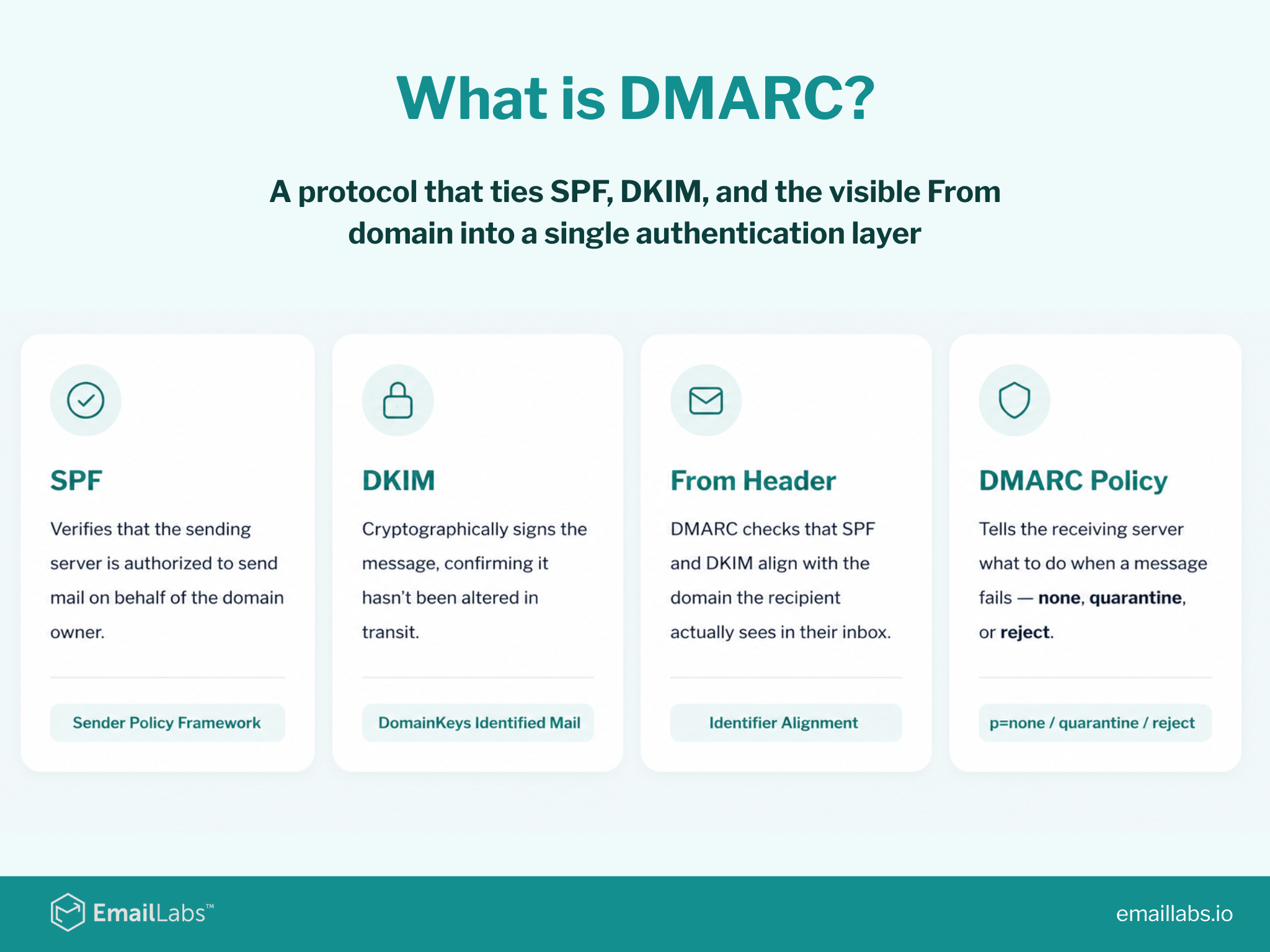
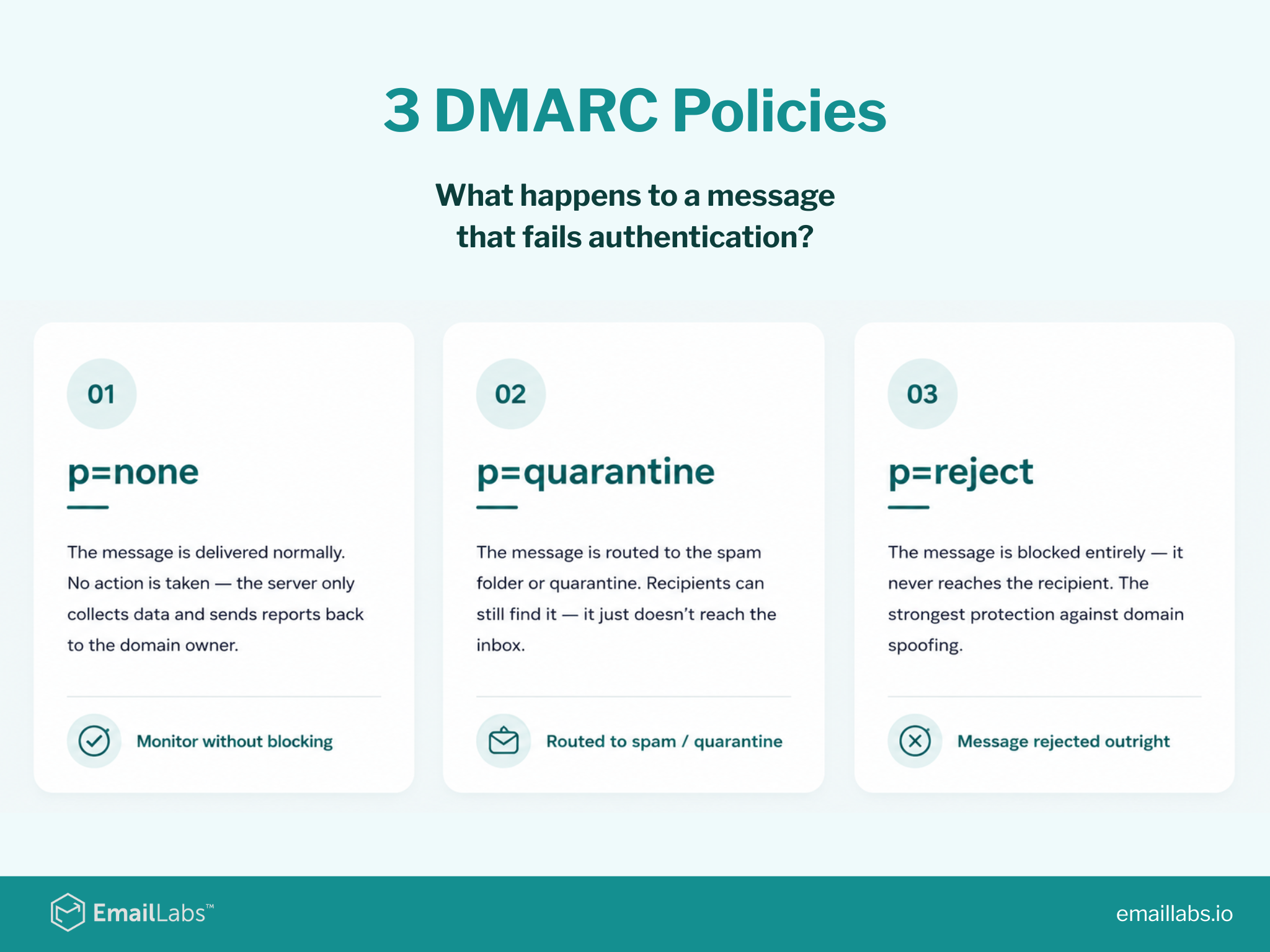
Domain owners can enforce one of three policies:
In early 2024, Google and Yahoo mandated DMARC implementation for bulk senders, effectively making it a baseline requirement rather than a best practice.
Marketer callout: Even if you’re not managing DNS records yourself, understanding these three policies helps you grasp the business implications of your authentication setup and know the right questions to ask your tech team when deliverability issues arise.
The original DMARC specification, documented in RFC 7489, was published in 2015 as an informational document rather than a formal internet standard. While the protocol became widely adopted, its implementation remained inconsistent – mailbox providers could interpret the spec in their own ways, and often did.
After years of work by the IETF (Internet Engineering Task Force) working group, the protocol underwent a comprehensive revision. The process took this long partly because the spec needed to address complex challenges that RFC 7489 hadn’t anticipated: indirect mail flows, Public Suffix Domain handling, and the growing complexity of the email ecosystem.
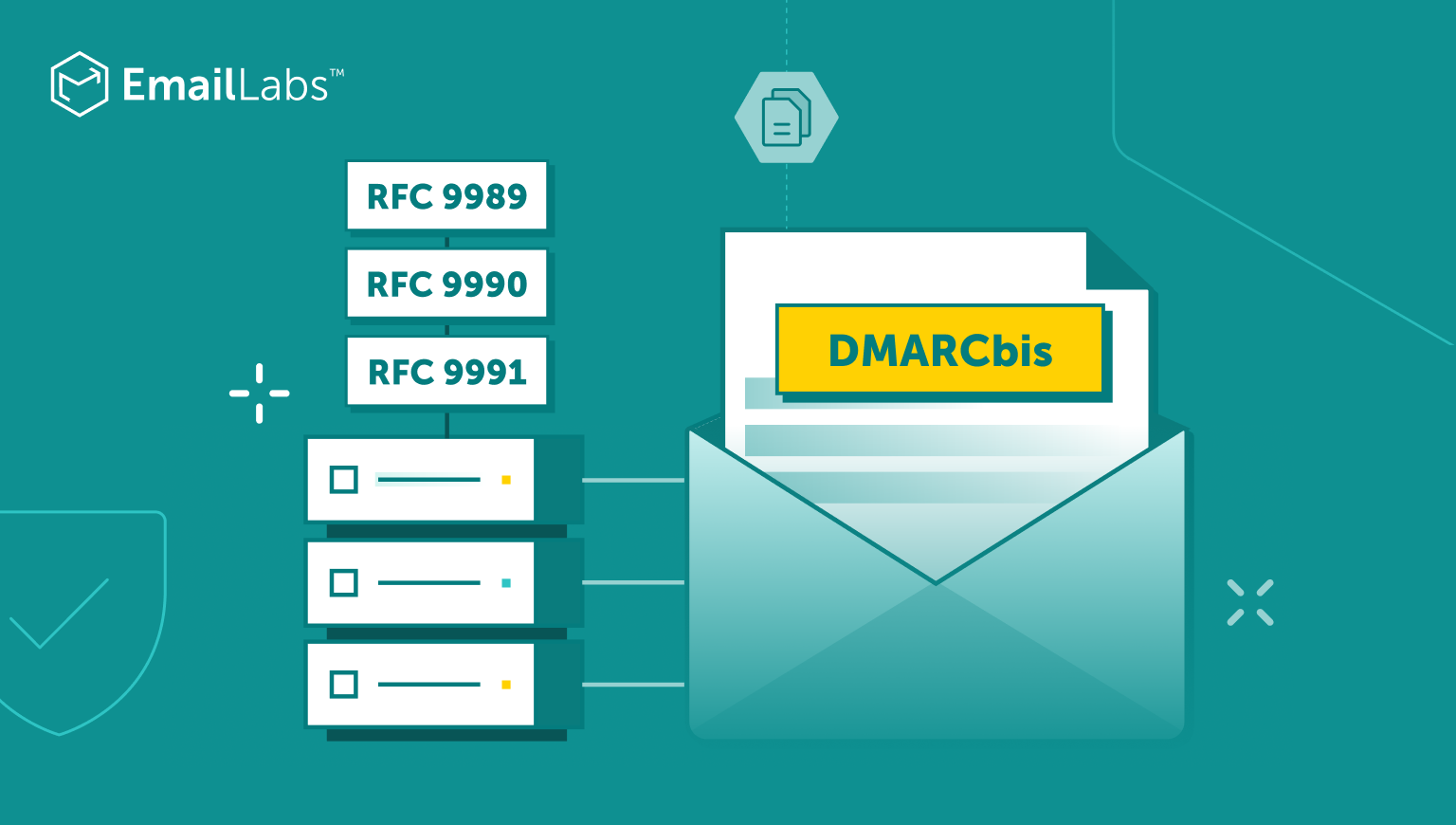
The updated specification, known as DMARCbis, is split into three dedicated documents:
Todd Herr, one of the editors of RFC 9989, confirmed the publication on LinkedIn, noting its significance for the broader email ecosystem. The full document is available via the RFC Editor.
With these publications, DMARC has officially achieved IETF Proposed Standard status. In practice, this means mailbox providers worldwide will interpret and implement the protocol more consistently. It also brings clearer definitions, better examples, and more actionable guidance for administrators – all immediately visible in how much more readable these documents are compared to RFC 7489.
Despite how comprehensive this update is, DMARCbis introduces no breaking changes. The concept of “DMARC2” simply does not exist, and that is by design: the new tags and revised rules are built so that servers running the legacy standard can safely ignore them without any errors.
All DMARC records must still start with v=DMARC1. That is good news for anyone managing email infrastructure. Existing, correctly configured records remain fully functional, and email administrators do not need to rush through mass DNS updates. The right time to plan strategic record updates is once major mailbox providers have fully implemented and validated the new specification on their end.
DMARCbis introduces several significant technical changes, each worth looking at separately. They cover the policy record structure, how the organizational domain is determined, and new conformance requirements.
The DMARC policy record structure has been updated. Some existing tags were deprecated due to low adoption or redundancy. At the same time, new parameters were added to meet the current demands of the email ecosystem.
| Deprecated Tag | New Tag | Technical Function |
|---|---|---|
| pct | t | The percentage parameter has been removed and replaced by the t (testing) tag, which allows policy testing without global enforcement. |
| rf | None | The reporting format parameter has been deprecated, as standard XML formats are now universally expected. |
| ri | None | The reporting interval parameter has been removed entirely. |
| None | np | Allows defining a DMARC policy specifically for non-existent subdomains. |
| None | psd | Used to declare a domain as a Public Suffix Domain. |
Marketer callout: If your tech team is using the pct tag (e.g., pct=50 for a gradual policy rollout), it’s worth planning a migration to the new t tag. The functionality is similar, but the new syntax is simpler and more predictable.
Until now, DMARC relied on the Public Suffix List (PSL) to determine the organizational domain for record discovery and identifier alignment. Relying on the PSL came with real operational drawbacks: it required manual updates, caused propagation delays, and introduced errors in complex domain structures.

RFC 9989 replaces the PSL with the DNS Tree Walk algorithm. Instead of querying a static external database, the system dynamically traverses the DNS hierarchy level by level until it precisely identifies the organizational domain boundary. This delivers significantly better support for Public Suffix Domain (PSD) environments and enables their full participation in the DMARC ecosystem.
The updated specification introduces a new section dedicated to what full DMARC participation actually requires. It establishes precise technical criteria for both domain owners and receiving servers. Turning informal best practices into formal requirements will help drive greater consistency across the global email infrastructure.
The most consequential change in DMARCbis concerns the approach to p=reject. Indirect mail flows, including forwarding and mailing lists, have been breaking DMARC identifier alignment for years. That technical limitation remains unresolved in the new specification as well.
RFC 9989 addresses this issue but introduces a much broader directive covering all mail verification. The specification outlines the following language for receiving servers:
“It is therefore critical that Mail Receivers MUST NOT reject incoming messages solely on the basis of a ‘p=reject’ policy by the sending domain.” (RFC 9989, Section 7.4)
As Todd Herr, one of the editors of RFC 9989, clarified, this applies to all incoming mail, not solely indirect flows. The document reiterates a fundamental architectural principle: the DMARC policy tag has always been, and remains, a request made by the Domain Owner. The IETF holds no authority to enforce behavior upon mailbox providers. Receiving servers retain full agency over their disposition decisions and are expected to use the p=reject value as one of several analytical signals, rather than the sole deciding factor. In the absence of additional context regarding the message source, treating verification failures as p=quarantine is highly recommended.
Marketer callout: If newsletters are distributed through external platforms or messages reach recipients via discussion lists, p=reject can silently block legitimate email. Before enforcing it, review DMARC reports for indirect flows and consult the technical team. Ultimately, the final disposition decision always rests with the receiving server.
Marketer callout: Once mailbox providers roll out the new spec, it’s worth keeping a closer eye on your aggregate report data. Watch for unexpected shifts in bounce rates or sudden changes in identifier alignment. Either could be a signal that something needs attention on the technical side.
DMARCbis doesn’t require immediate action, but it’s a good opportunity to audit your configuration and rethink your authentication strategy. Here’s what to focus on depending on your role.
The publication of RFC 9989, 9990, and 9991 is not an isolated event. It is the next phase in a deliberate, multi-year push by the email industry toward universal and enforceable authentication.
Things are moving quickly. The sender requirements introduced by Google and Yahoo in early 2024 pushed senders who had been dragging their feet on DMARC to finally act. DMARCbis formalizes and standardizes what has effectively become the market baseline.
Meanwhile, DKIM2 is in active development, designed to solve the indirect flow problem at its source rather than working around it. ARC, the protocol built as a temporary fix for that same problem, has already been formally proposed for deprecation.

Taken together, these developments point in one clear direction: stronger, more predictable, and harder-to-abuse email authentication at every stage of delivery. For high-volume senders, the takeaway is straightforward. Stay close to these changes, because the next steps will come fast.

Product and Technical Insights Specialist
Natalia abandoned her career as an experimental biologist for the digital universe and new technologies. She likes to know something about everything and everything about something. Breathlessly follows and describes news from the email world. Supports EmailLabs users in integrating, analyzing, and reporting deliverability. Helps to increase domain security with implemented DNS records and BIMI standard, moreover educates on good mailing practices.
See more articles
We live in a world where your customers switch seamlessly between laptops, smartphones, and tablets. They navigate a complex digital ecosystem – checking emails, using mobile apps, and reacting...

We are delighted to announce that Vercom S.A., the company behind the EmailLabs project, has successfully completed the ISO 22301 certification process. This significant achievement underscores our commitment to...

EmailLabs, as part of the Vercom group, proudly announces its full commitment to aligning its ICT services with the latest cybersecurity standards. In response to dynamically changing regulations, the...
We are pleased to announce that MessageFlow, a product from the Vercom S.A. group, has received the prestigious CSA (Certified Senders Alliance) Certification. This recognition not only underscores the...
Compliance & Security, Email Marketing, Security
TL;DR DMARCbis is now official: After years of work by the IETF working group, the DMARC specification has been formally updated. Three new documents, RFC 9989, RFC 9990, and...

Email Marketing, Gmail, New feature
TL;DR Gmail Live: a new feature enabling natural language voice search in the inbox, powered by the Gemini model. AI Inbox and AI Overviews: a revamped inbox interface featuring...
Best practices, Best practices, Email Authentication
TL;DR: Strategic Takeaways for C-Level and Marketing Leaders DKIM2 is not a minor DNS configuration update. It is a systemic response to two critical business problems: Replay attacks: scenarios...
Compliance & Security, Email Marketing, Security
TL;DR DMARCbis is now official: After years of work by the IETF working group, the DMARC specification has been formally updated. Three new documents, RFC 9989, RFC 9990, and...
Email Marketing, Gmail, New feature
TL;DR Gmail Live: a new feature enabling natural language voice search in the inbox, powered by the Gemini model. AI Inbox and AI Overviews: a revamped inbox interface featuring...
Best practices, Best practices, Email Authentication
TL;DR: Strategic Takeaways for C-Level and Marketing Leaders DKIM2 is not a minor DNS configuration update. It is a systemic response to two critical business problems: Replay attacks: scenarios...
AI, Antispam, Best practices, Deliverability
C-Level TL;DR: Strategic Takeaways Recipient consent as a foundation (Item 0): Sending email messages without explicit recipient consent (opt-in) poses a significant risk to your sending infrastructure. Attempting to...
AI, Antispam, Best practices, Deliverability
Executive TL;DR: Strategic Takeaways Deliverability Schism: The growing divide between sales automation technologies and the security standards enforced by major global mailbox providers (collectively referred to as MAGY) is...
Modern email systems no longer treat the primary inbox as the default destination for every message. The final classification of an email is the result of a multistage evaluation...
Best practices, Maile marketingowe, Marketing E-mails, Transactional Emails
Mass email sending is a critical strategy for business owners, marketers, developers, and nonprofit managers looking to scale their outreach. Whether you are announcing a new product feature, distributing...

Best practices, Marketing E-mails
Customer feedback is the fuel for business growth, but gathering it effectively requires more than just a list of questions. Survey emails remain the most direct channel for understanding...

Best practices, Email Marketing, Pytania i odpowiedzi
Mail merge combines a template document with data to create personalized communications. This technique saves time by automatically generating individualized letters, emails, and labels without manual entry. What Is...