
Gmail, Google and Yahoo's Requirements, Updates
Gmail, Google and Yahoo's Requirements, Updates

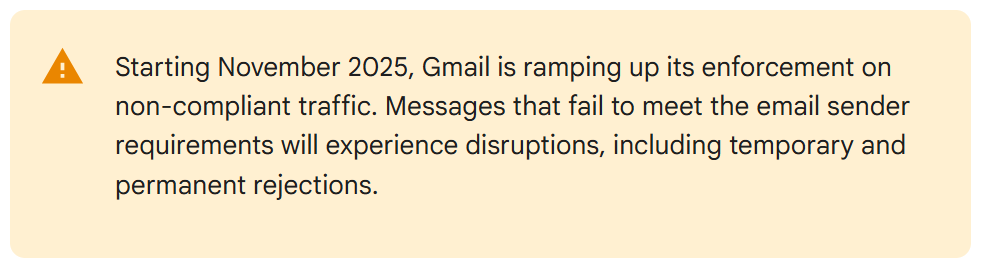
Gmail’s educational phase has ended. Google has officially announced the start of a new phase – the Gmail Enforcement Phase – which begins to take effect in November 2025.
From now on, messages that fail to meet the requirements introduced in February 2024 will no longer just be routed to spam – they’ll be actively rejected at the protocol level. As stated in Google’s official announcement:
Important Note: These requirements and enforcement policies apply to messages sent to personal Gmail accounts (ending in @gmail.com or @googlemail.com). These rules don’t apply to inbound mail within Google Workspace (for corporate domains).
This is a fundamental change. Google is moving from an educational and warning phase to actively blocking non-compliant traffic (the enforcement phase). For bulk senders, this means that technical configuration problems will no longer just result in a drop in open rates – they will mean a complete failure to deliver the message.
This decision is the culmination of the process that began in early 2024 (which we wrote about in our articles on Gmail and Yahoo requirements) and is directly linked to the recent shift in philosophy within Google’s tools.
This escalation of penalties is not surprising. The latest announcement fits perfectly with the shift in philosophy that took place in late October 2025.
Google officially announced that on October 31, 2025, it would shut down the older version of Postmaster Tools, according to the message:

Interestingly, as of this article’s publication date (November 5, 2025), the old panel is still accessible, and historical data on Domain Reputation and IP Reputation can still be checked there. However, this is a transitional state. The official sender evaluation philosophy has already irrevocably moved to the new version of the tool.
With this move, Google has sent a clear signal: historical reputation metrics – the Domain Reputation and IP Reputation dashboards, which many senders treated as the main indicator of their sending health for years – are losing relevance. The tool’s API has also been updated, confirming the full transition to the new evaluation model. This shift shows Google is moving away from the often-misleading concept of IP reputation and putting full emphasis on strict domain-level compliance.
The new version, Postmaster Tools v2, is significantly simplified and relies almost exclusively on the new “Compliance Status” tab.
The dashboard no longer shows reputation charts on a Bad–Low–Medium–High scale. Instead, Google evaluates senders in a binary (Pass/Fail) fashion across key categories, assigning only a status:
Furthermore, Google’s new philosophy doesn’t stop at technical compliance. Recent analyses show Gmail has begun sorting the “Promotions” tab based on relevance, not just recency. This means Google is introducing a two-step evaluation: first, “Compliance Status” decides if an email will be accepted at all, and then the “relevance” algorithm decides how high it will be displayed in the inbox.
This is a fundamental difference compared to Yahoo’s philosophy (which we described in this article [link]). While Yahoo’s “Insights” focuses mainly on user perception (measuring Spam Complaint Rate), Google’s Postmaster Tools v2 focuses on hard, binary technical compliance as the first, mandatory gate.
The conclusion is simple: Google is no longer asking, “What is your reputation?” but rather “First: Are you 100% compliant with our requirements?“.
The announcement about blocking traffic starting in November 2025 is a direct consequence of this philosophy. If your “Compliance Status” in Postmaster Tools v2 shows Fail (meaning you didn’t pass that first gate), you must expect your messages to not even land in spam – they will be permanently rejected.
Google’s new, strict enforcement targets key technical and procedural areas. The table below summarizes which rules will be enforced and the consequences of failing to meet them.
These changes primarily affect bulk senders (sending to personal Gmail accounts). Google also notes that new domains (those that have not sent >5k emails/day since Jan 1, 2024) will face a faster enforcement ramp-up.
| Area | Enforcement Rule | Possible Consequence (Sample SMTP Error Codes) |
|---|---|---|
| Authentication Alignment | SPF and DKIM must align with the “From:” header domain. | 4.7.32 (Warning) or 5.7.26 (Rejection) / Spam |
| SPF/DKIM Presence | Both methods must be correctly implemented. | 4.7.27 (SPF Fail) / 4.7.30 (DKIM Fail) / 5.7.27 or 5.7.30 (Rejection) |
| TLS Encryption | All messages must be sent over TLS. | 4.7.29 (Warning) or 5.7.29 (Rejection) |
| Valid DNS / rDNS | Forward and Reverse DNS records (PTR record) are required. | 4.7.23 (Warning) or 5.7.25 (Rejection) |
| RFC 5322 Compliance | Messages must have valid headers and syntax. | 5.6.0 – Rejection (Permanent Failure) |
| DMARC Policy | A DMARC record must exist (minimum p=none). | 4.7.31 / 4.7.40 (Warning/Rate-limit) / Loss of mitigation support |
| Spam Complaint Rate | Must remain below 0.3%. Google recommends a target of <0.1%. | Loss of mitigation support at >0.3% |
| One-Click Unsubscribe | Required for marketing messages (per RFC 8058). The implementation deadline was June 1, 2024. | Loss of mitigation support. Google actively tracks unsubscribes and may automatically filter the sender’s future emails to spam for that user. (Transactional messages are exempt from this requirement). |
| Unsubscribe Processing | Unsubscribe requests must be processed within 2 days (48h). | Loss of mitigation support and the risk of future emails being automatically filtered to spam. |
Simply put: Google will no longer just filter. It is starting to actively reject messages at the SMTP protocol level if they violate fundamental technical rules.
When Gmail talks about “temporary and permanent rejections,” it is referring to the standard SMTP response codes that the sending server receives in real-time.
Expert Tip: If you notice a sudden increase in 5xx errors from Gmail servers after November 2025, it is likely a direct result of failing to meet authentication (SPF/DKIM/DMARC) or encryption requirements.
Google’s announcement is a clear signal to the entire industry: there is no more room for “almost” compliant configurations. The new, binary Compliance Status philosophy in Postmaster Tools v2, combined with the threat of permanent message rejection, completely changes the priorities for every sender. Enforcement is no longer a theory – it is becoming a fact.
For bulk senders, this means two things:
At EmailLabs, we know that the foundation of deliverability is ensuring 100% technical compliance. Our platform and team of experts provide the tools and knowledge to help your company navigate these changes without disruption:
Don’t wait until Gmail starts rejecting your messages. Contact us to conduct a deliverability audit and ensure your sending practices are fully compliant with Google’s new rules.

Product and Technical Insights Specialist
Natalia abandoned her career as an experimental biologist for the digital universe and new technologies. She likes to know something about everything and everything about something. Breathlessly follows and describes news from the email world. Supports EmailLabs users in integrating, analyzing, and reporting deliverability. Helps to increase domain security with implemented DNS records and BIMI standard, moreover educates on good mailing practices.
See more articles
We live in a world where your customers switch seamlessly between laptops, smartphones, and tablets. They navigate a complex digital ecosystem – checking emails, using mobile apps, and reacting...

We are delighted to announce that Vercom S.A., the company behind the EmailLabs project, has successfully completed the ISO 22301 certification process. This significant achievement underscores our commitment to...

EmailLabs, as part of the Vercom group, proudly announces its full commitment to aligning its ICT services with the latest cybersecurity standards. In response to dynamically changing regulations, the...
We are pleased to announce that MessageFlow, a product from the Vercom S.A. group, has received the prestigious CSA (Certified Senders Alliance) Certification. This recognition not only underscores the...
Compliance & Security, Email Marketing, Security
TL;DR DMARCbis is now official: After years of work by the IETF working group, the DMARC specification has been formally updated. Three new documents, RFC 9989, RFC 9990, and...

Email Marketing, Gmail, New feature
TL;DR Gmail Live: a new feature enabling natural language voice search in the inbox, powered by the Gemini model. AI Inbox and AI Overviews: a revamped inbox interface featuring...

Best practices, Best practices, Email Authentication
TL;DR: Strategic Takeaways for C-Level and Marketing Leaders DKIM2 is not a minor DNS configuration update. It is a systemic response to two critical business problems: Replay attacks: scenarios...
Compliance & Security, Email Marketing, Security
TL;DR DMARCbis is now official: After years of work by the IETF working group, the DMARC specification has been formally updated. Three new documents, RFC 9989, RFC 9990, and...
Email Marketing, Gmail, New feature
TL;DR Gmail Live: a new feature enabling natural language voice search in the inbox, powered by the Gemini model. AI Inbox and AI Overviews: a revamped inbox interface featuring...
Best practices, Best practices, Email Authentication
TL;DR: Strategic Takeaways for C-Level and Marketing Leaders DKIM2 is not a minor DNS configuration update. It is a systemic response to two critical business problems: Replay attacks: scenarios...

AI, Antispam, Best practices, Deliverability
C-Level TL;DR: Strategic Takeaways Recipient consent as a foundation (Item 0): Sending email messages without explicit recipient consent (opt-in) poses a significant risk to your sending infrastructure. Attempting to...

AI, Antispam, Best practices, Deliverability
Executive TL;DR: Strategic Takeaways Deliverability Schism: The growing divide between sales automation technologies and the security standards enforced by major global mailbox providers (collectively referred to as MAGY) is...

Modern email systems no longer treat the primary inbox as the default destination for every message. The final classification of an email is the result of a multistage evaluation...

Best practices, Maile marketingowe, Marketing E-mails, Transactional Emails
Mass email sending is a critical strategy for business owners, marketers, developers, and nonprofit managers looking to scale their outreach. Whether you are announcing a new product feature, distributing...

Best practices, Marketing E-mails
Customer feedback is the fuel for business growth, but gathering it effectively requires more than just a list of questions. Survey emails remain the most direct channel for understanding...

Best practices, Email Marketing, Pytania i odpowiedzi
Mail merge combines a template document with data to create personalized communications. This technique saves time by automatically generating individualized letters, emails, and labels without manual entry. What Is...

